Inside Calibre
How We Authenticate a Daytona, Step by Step
A Daytona review is not one dramatic test. It is a documented comparison of the exact reference, its components, operation and provenance — plus a willingness to pause when the pieces do not agree.
Calibre Desk · June 5, 2026 · 8 min read
At a glance
- Authentication, condition and provenance are separate questions; a good review keeps them separate before bringing them together.
- A serial number or warranty card can support a case, but neither replaces reference-correct component review.
- When a watch needs a manufacturer-backed determination, Rolex Certified Pre-Owned is a distinct programme offered through participating Official Jewelers.
Start by defining the claim
‘Authentic’ is not a complete description of a Daytona. A marketplace review has to separate at least four questions: is the watch consistent with the stated reference, are its visible components appropriate to that reference and era, does it function correctly, and does the seller’s account of ownership and service history hold together? A watch can pass one test and still require a different conclusion on another.
That distinction protects both sides of a transaction. A factory service replacement can be genuine but important to disclose. A correct-looking watch can be poorly maintained. A complete set of papers can support provenance, but papers alone do not prove every component now fitted to the watch.
1. Document the reference before the details
The review begins with a record of the seller’s declared reference, serial information, case material, dial configuration, bracelet and included accessories. Photographs should show the watch from enough angles to evaluate case lines, bezel, rehaut, pushers, clasp and the dial without relying on one flattering image. Serial information should be handled carefully and not unnecessarily exposed in public listings.
The goal is a baseline. Once the exact reference and approximate production context are established, every later observation has something real to be compared against. A bezel font, dial layout or bracelet code cannot be meaningfully assessed in isolation.
2. Check external components and operation
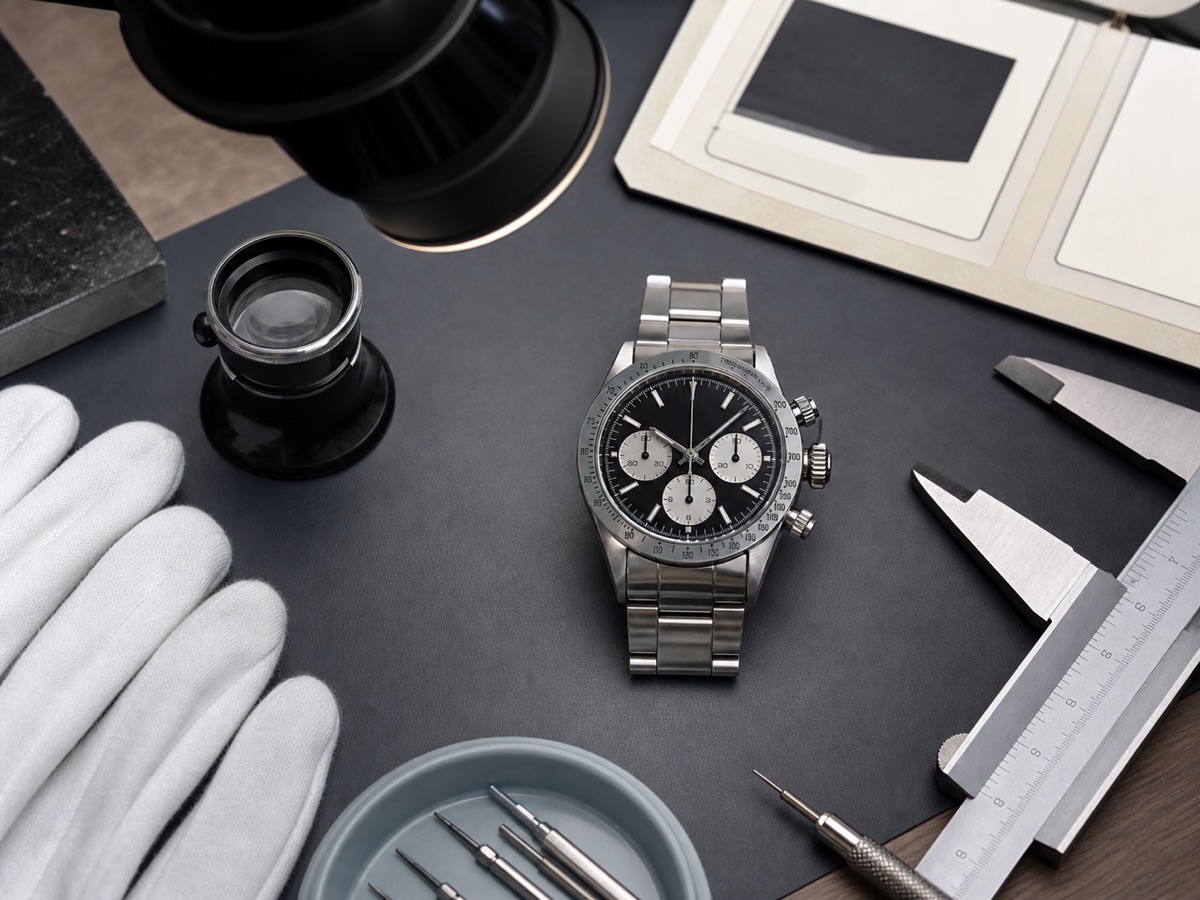
At the bench, the reviewer compares the case, dial, hands, crystal, bezel, bracelet and clasp against the expected configuration for that reference. Finishing quality matters, but so does consistency: an unusually sharp case beside a heavily worn bracelet, or a dial whose age does not agree with the rest of the watch, deserves an explanation rather than a quick pass.
The chronograph is then operated through its full sequence. Start, stop, reset and sub-dial behaviour should be coherent and the reset should land precisely. This is a functional screen, not a substitute for a movement inspection. When a deeper review is necessary, opening the case should be done by a qualified professional with the right tools and a documented reason.
3. Treat papers as evidence, not a verdict
A warranty card, invoice or service document is valuable when its names, dates and identifying details agree with the watch. It becomes more useful when it is part of a continuous story: original purchase, sensible ownership history, recorded service and a seller who can answer ordinary questions without improvising. It is less useful when it is being asked to override visible mismatches.
This is why an authentication process should preserve its notes and photographs. If a buyer asks why a bracelet was considered period-correct, or why a replacement part was accepted, the answer should be evidence that can be reviewed — not a vague assurance that the watch ‘looked right.’
4. Know when the right answer is to stop
A mismatch does not always mean a counterfeit, but it does mean the process is incomplete. Unexplained serial damage, inconsistent engravings, non-conforming dial details, undisclosed replacement parts or a seller who will not support reasonable inspection are all reasons to pause. The cost of walking away is usually lower than the cost of owning a question mark.
Calibre’s marketplace review is not a manufacturer warranty or a substitute for a brand determination. Rolex’s Certified Pre-Owned programme is separate: it applies to eligible second-hand watches sold by participating Official Jewelers, whose experts verify each component and provide the programme’s guarantee. Understanding the boundary lets buyers choose the level of assurance their purchase requires.
Sources & further reading